
Read Atkinson County Property Tax
Two offices split the job. In Atkinson County, the Tax Assessor keeps the owner roll and parcel facts. That same office also tracks fair market value, assessed value, and exemptions. The Tax Commissioner issues bills, accepts payment, and handles collection and delinquency questions. The county GIS map adds helpful value-history and tax-district fields. It is not a certified tax card, though.
| Field | What It Shows | Where |
|---|---|---|
| Fair market value | Assessor's estimate of value under Georgia rules | Tax Assessor roll |
| Assessed value | Standard taxable assessment base before exemptions | Tax Assessor roll |
| Exemption flags | Homestead, senior, conservation, or other treatment | Tax Assessor |
| Tax district | Jurisdiction used in the tax calculation | Roll, GIS, and bill |
| Bill and status | Charge, payment, receipt, or collection state | Tax Commissioner |
Georgia law generally sets assessed value at 40 percent of fair market value. Special assessment rules can change that figure for certain properties. The final tax bill also reflects millage rates and any exemptions. Keep in mind that a deed sale price is transaction evidence. It is not the tax base itself. And the 40 percent rule never means an owner pays 40 percent of market value as tax. That rule only sets the assessed value.
Look Up Atkinson County Tax
Start every Atkinson County property search with the parcel number. It links the assessment side and the collection side of the records. The county's Government Window gateway lists Property Taxes and Tax Commissioner Fonda H. Lee, though it publishes no sample bill-detail screen. The portal may show too little detail. For a current balance, receipt, payoff, or delinquency figure, confirm directly with the office.
- Find the parcel in SGRC GIS or the qPublic assessment route and copy its parcel number.
- Open Government Window and match the tax account to the same parcel and year.
- Compare fair market value, assessed value, tax district, and exemption status.
- Ask the Tax Commissioner to confirm payment, delinquency, lien, payoff, or sale status.
- Assessed value
- The statutory portion of fair market value used as the tax base.
- Millage
- A tax rate stated in mills and applied to taxable assessed value.
- Homestead exemption
- Qualified relief tied to an eligible owner's primary home.
- Tax lien
- A recorded or statutory claim tied to unpaid tax.
Use Atkinson County's Certified Tax Roll
The Atkinson qPublic landing states that assessment information comes from the last certified tax roll. It also warns that other data may change. Its link opens the Schneider application. The county does not document that application. There are no published search labels, required fields, or sorting rules. Sketches, coverage, and current charges go undocumented as well.
Treat the roll as a dated snapshot. A deed recorded after certification may name a newer owner of record. A recent closing may matter to you. Compare the latest deed and its recording date against the roll. The county publishes no official closing-to-roll lag or refresh schedule.
The official landing page displays the source along with its certified-roll warning:
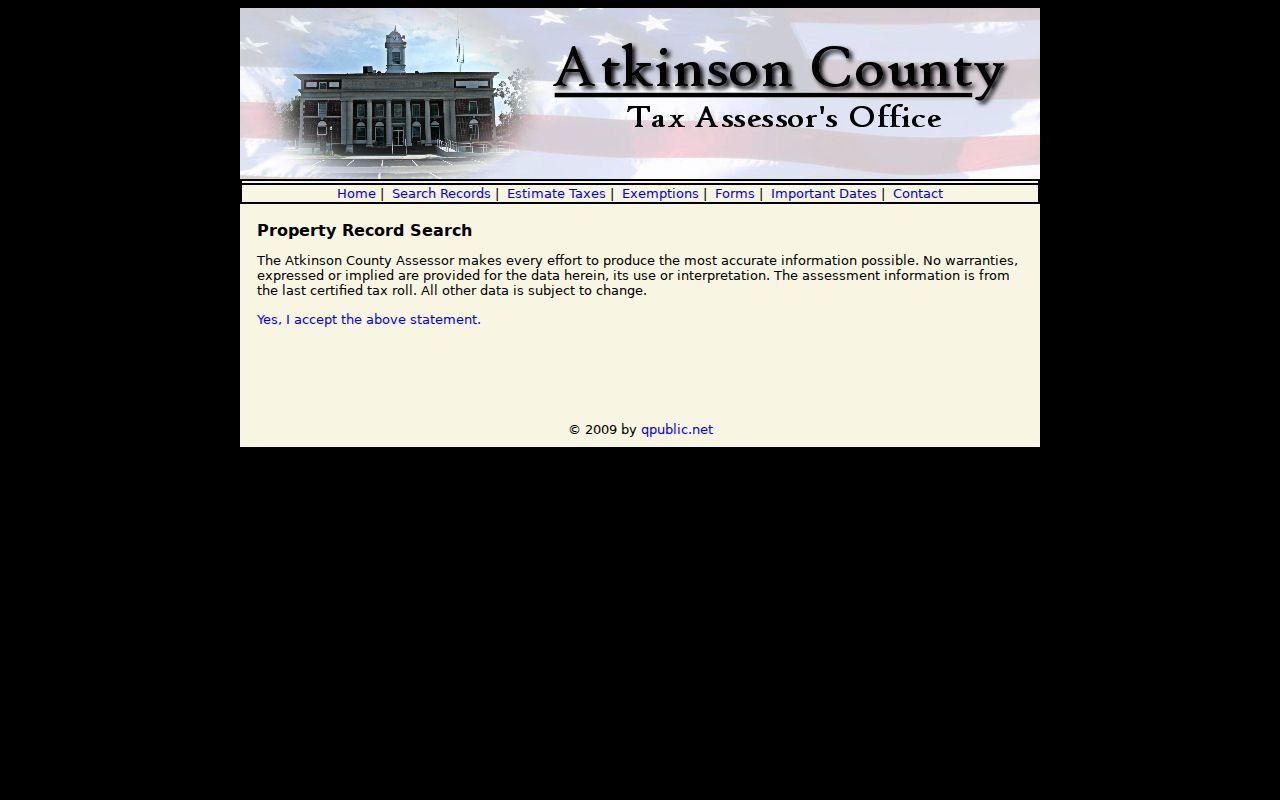
Note: That warning is why a current assessment result and a newly recorded deed should always be checked together.
Check Atkinson County Tax Exemptions
Atkinson County's assessor materials cover several programs. They include standard homestead relief, age-based and senior provisions, conservation use, and Freeport treatment. Each program carries its own qualifications and filing route. A homestead flag on the GIS map is an assessment clue. It is not proof of ownership or a deed.
Conservation-use valuation runs on a ten-year covenant. That long commitment makes current status, renewal data, and transfer effects key questions. Each of those belongs with the assessor. Farm use, acreage, or an old flag alone proves nothing about qualification. Ask instead for the current application, the deadline, and the recorded status.
The official exemptions and appeal page lists the filing and appeal rules:
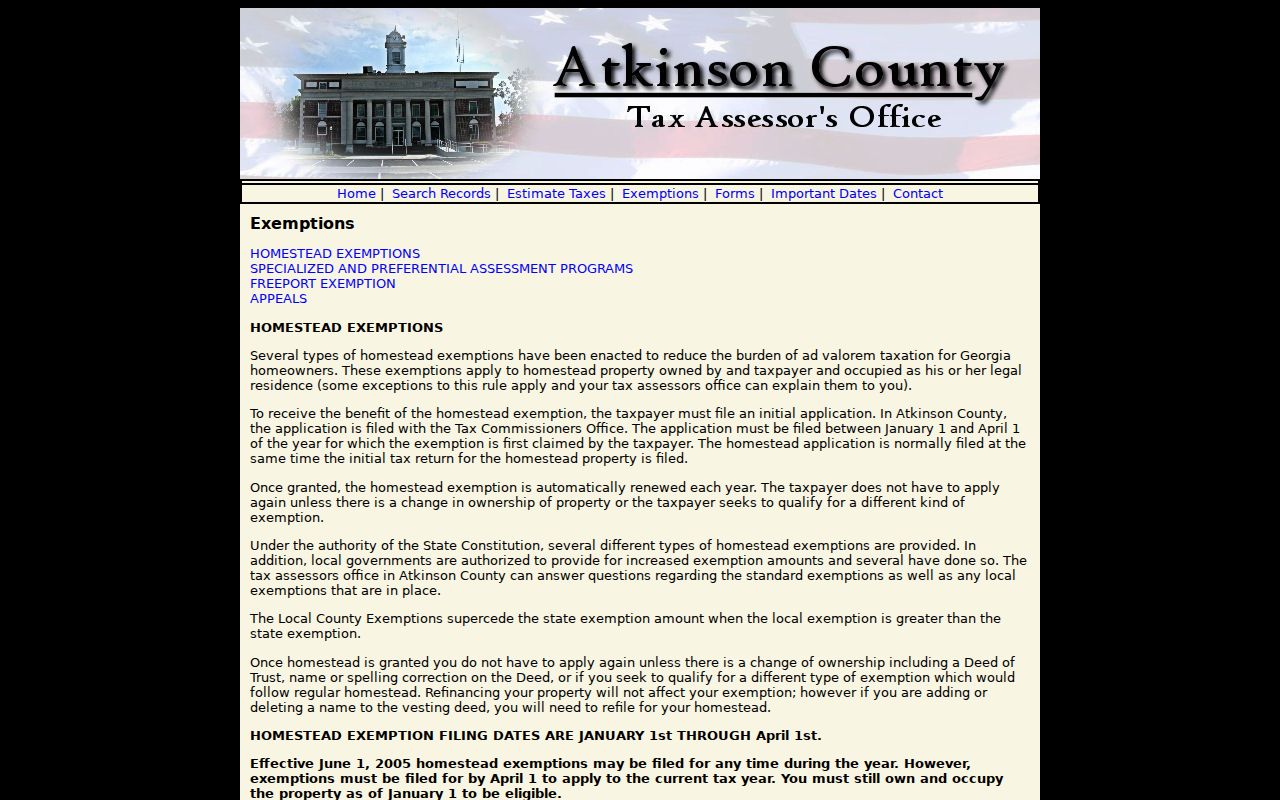
Note: Its filing and appeal language supplies the proper route, while the assessor confirms eligibility in a specific case.
Interpret Atkinson County Tax Values
The SGRC parcel service exposes CURR_VAL, historical years, and values. It also exposes sale value, home-exemption, current-use renewal, and tax-district fields. One sample parcel showed a current value of 160,092. It showed history values of 70,056 for both 2024 and 2023. Those are database fields from a single parcel. They are not countywide trends.
The same record showed a sale value of zero. That does not prove a zero-dollar sale. The field may simply be unpopulated or unrelated to the latest recorded transfer. When consideration matters, check the deed and PT-61 or transfer material. Compare the tax year too before treating a historic value as current.
Note: A GIS value helps orient a tax search. It does not replace the certified assessment notice or tax bill.
Separate Atkinson County Tax Liens
A delinquent account answers one question. A recorded tax lien, a tax-sale notice, and a tax-sale deed answer different questions. Government Window serves as the payment route. The Tax Commissioner holds collection status. Georgia DOR notes that tax liens are filed in the county clerk's general execution docket. The Clerk and GSCCCA hold the recorded history and any release.
The county publishes no delinquent list, sale calendar, redemption screen, or bill-detail result online. So ask for the parcel, the tax years, and the balance. Ask also for fees, payment state, notice date, and sale status. Then match any filed lien or tax deed by owner and legal description. Remember that a paid bill alone does not establish a recorded lien's release.
A tax-sale notice begins a process; it is not a completed sale. A tax-sale deed is a recorded conveyance. It can carry redemption and title issues far beyond an annual bill. A buyer should gather the notice, ledger, sale papers, deed, legal description, and later releases. Then seek advice on their effect.
Track Atkinson County's Tax Digest
Atkinson County posted a "2026 Five Year Tax Digest" notice on September 1, 2026. The notice shows the county still publishes digest material through its public-notice channel. Treat the digest as context, not authority. A parcel's certified roll entry, assessment notice, and current bill each matter. Each one controls what is actually owed.
Read the table labels before drawing conclusions. A countywide total cannot become a Pearson or Willacoochee parcel trend. A planned bypass or industrial park in the county plan is not a comparable sale. It is not a parcel revaluation either.
Atkinson County's land spans agricultural, timber, residential, industrial, and commercial uses. Different classes and special programs move digest totals in different ways. Conservation use follows its own valuation path and covenant. Compare the same class and the same year. Do not read one total as the value change for every tract.
Request Atkinson County Tax Records
When an online screen comes up short, submit a focused request. Name the parcel and the situs and mailing address. Give the owner or entity, the tax year, and the tax district. State the record you want. Ask for an existing assessment card, notice, appeal decision, bill, receipt, delinquency record, or tax-sale document. Ask for electronic form when practical.
The Georgia Open Records Act generally requires production within three business days. Otherwise the office must send a written estimate, costs, and any cited exemption. Copy charges cannot exceed 25 cents per page, and the most economical means should be used. The agency does not have to create a new report or answer a question. So request the record itself, not a custom explanation.
Split assessment questions from collection questions. For assessment history, ask for the existing parcel card and value changes. Request the land and improvement parts, exemption flags, review date, and appeal disposition. For collection, request the bill, adjustments, payments, receipt, balance, notices, and sale status. Separate requests route each question to the right office.
Include prior owner and address variants if anything changed. GIS stores mail fields apart from situs fields. Pearson may be a postal clue rather than a city-boundary finding. The parcel number and legal description keep the request tied to the land.
Keep the notice date and certified-roll year attached to every value. An appeal decision can change an assessment while the public map still shows earlier history. A payment can post after a bill was downloaded. A deed recorded near year end can name a grantee. That grantee does not appear until a later roll. Comparing dated records explains most apparent conflicts without assuming an office made an error.
Request written confirmation of the current account before a purchase or payoff. Do this when the portal lacks detail. Identify each tax year. Ask whether interest, penalties, collection costs, or a recorded execution affect the quoted balance. Then search the clerk's docket for any lien and release. This paired check keeps a current payment figure separate from the land-record history.
Save both the assessment source and the collection source with the response date. That record shows the number's source. It may be the certified roll, GIS history, annual bill, payment ledger, or clerk docket. It also keeps an exemption flag or old balance from being mistaken for current status.
Appeal an Atkinson County Assessment
An owner may appeal value, taxability, uniformity, or denial of an exemption. The county qPublic instructions state that an appeal must be filed within 45 days from the date on the annual assessment notice. File with the Board of Tax Assessors and keep proof of delivery. Review the parcel facts, land and improvement data, exemptions, and comparable evidence before stating the grounds.
The appeal challenges the assessment, not the Tax Commissioner's arithmetic or payment posting. Contact the assessor at 19 Roberts Avenue West, Suite 1E, Pearson, phone 912-422-7382, for assessment issues. Contact the commissioner at 16-A Smith Road West, Pearson, phone 912-422-7381, for bills and collection.
Appeal window. File within 45 days of the assessment notice date. Do not use the tax-bill due date as the appeal deadline.